
AI's Bug Bonanza: When Automation Overwhelms Human Review
Published on May 19, 2026
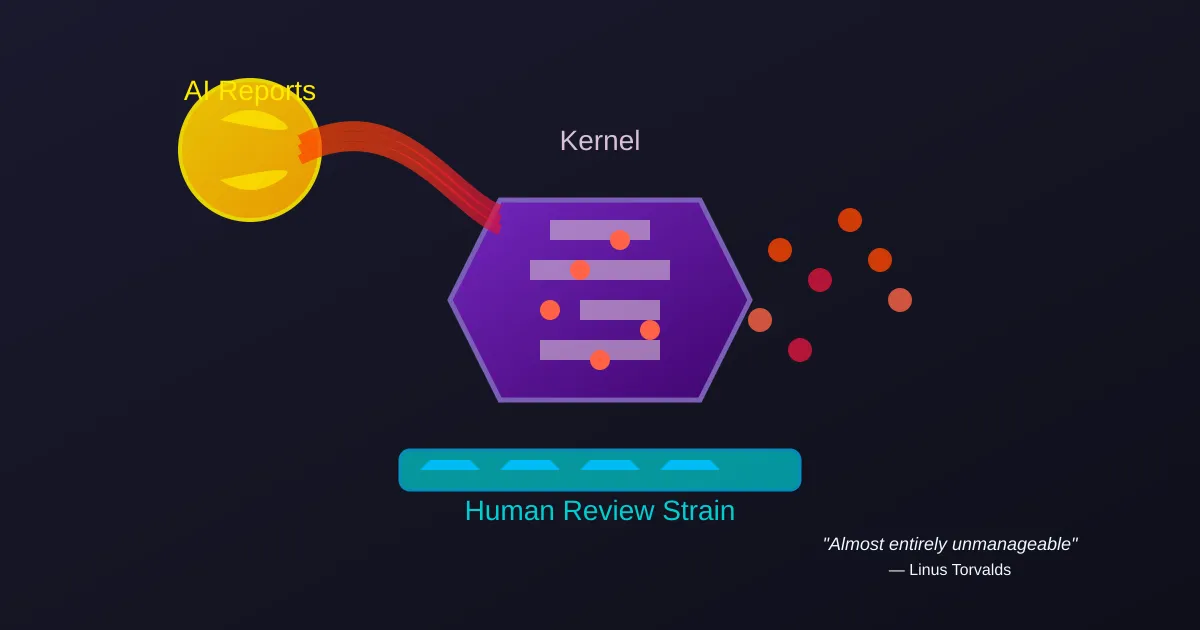
Quick Answer: Linus Torvalds, creator of Linux, notes that the growing volume of AI-detected bug reports, while highlighting issues, is making the kernel’s security list “almost entirely unmanageable” due to the sheer number and often low signal-to-noise ratio, posing a significant challenge for human maintainers.
The promise of Artificial Intelligence in software development has always been alluring: faster coding, automated testing, and ultimately, bug-free software. AI-powered tools are indeed becoming incredibly adept at sifting through millions of lines of code, identifying vulnerabilities, and flagging potential issues that human eyes might miss. Yet, this very efficiency is creating an unforeseen challenge, even for the titans of open source. Linus Torvalds, the venerable creator of the Linux kernel, recently voiced a growing concern: the deluge of AI-detected bug reports is making the kernel’s security list “almost entirely unmanageable.”
This statement isn’t a critique of AI’s capability to find bugs; rather, it’s a stark revelation about the paradox of AI-driven code quality. As AI tools become more powerful and pervasive, they generate an unprecedented volume of data—data that still requires human interpretation, prioritization, and resolution. For developers, founders, and tech enthusiasts, Torvalds’ observation serves as a crucial case study in the evolving landscape of human-AI collaboration in software engineering, highlighting both the immense potential and the significant hurdles that lie ahead.
The AI Paradox: Efficiency Meets Overload
For decades, software quality assurance has relied on a combination of manual testing, automated unit tests, integration tests, and static analysis tools. While effective, these methods often struggled with the sheer scale and complexity of modern software, particularly projects like the Linux kernel which comprises millions of lines of code contributed by thousands of developers globally.
Enter AI. Machine learning algorithms, especially those leveraging natural language processing (NLP) and deep learning, have dramatically advanced the field of static and dynamic code analysis. Tools can now:
- Identify complex patterns: AI can learn from vast codebases to detect subtle anti-patterns, potential memory leaks, race conditions, and security vulnerabilities that traditional regex-based static analyzers might miss.
- Automate fuzzing: AI-driven fuzzing engines intelligently generate test inputs to uncover edge cases and crash points, far more efficiently than random fuzzing.
- Contextualize issues: Some advanced AI tools attempt to understand the intent behind the code, offering more contextual bug reports.
The result? An explosion in the number of detected issues. What once took weeks of meticulous manual review or sophisticated tooling to find a handful of critical bugs can now be done in hours, yielding hundreds or even thousands of potential issues. While this sounds like a dream for software quality, it quickly turns into a nightmare for the human developers tasked with sifting through these reports. The core problem, as Torvalds points out, is the “signal-to-noise ratio.” Many AI-detected issues might be:
- False positives: The AI misinterprets code or flags non-issues.
- Low-priority: Technically a bug, but in a rarely used path, with minimal impact, or easily fixable later.
- Duplicates: Different AI runs or tools reporting the same underlying issue.
- Lacking context: The report identifies a problem but doesn’t provide enough information for a human to quickly understand the root cause or optimal fix.
This deluge creates significant overhead, forcing highly skilled maintainers to spend valuable time triaging, verifying, and discarding reports instead of focusing on critical development or genuine, high-impact fixes.
Linus Torvalds’ Perspective: The Kernel’s Crucible
Linus Torvalds’ comments carry immense weight, given his role at the helm of one of the world’s most critical software projects. The Linux kernel is the backbone of countless systems, from smartphones and servers to supercomputers and embedded devices. Its integrity and security are paramount.
The kernel development model relies heavily on a decentralized, trust-based system of maintainers. These individuals are not just bug fixers; they are architects, reviewers, and gatekeepers. They understand the intricate dependencies, historical context, and long-term vision of different kernel subsystems. When an AI tool flags a potential bug in the kernel, it’s not just a matter of “is this code wrong?” but also:
- Is it truly a bug in this context? A pattern considered problematic in one part of the kernel might be intentional and safe in another.
- What are the implications of a fix? A seemingly simple fix might introduce regressions elsewhere or contradict a design principle.
- Who is responsible for this code? Directing the report to the right subsystem maintainer requires deep project knowledge.
- Is the report actionable? Does it provide enough information for a maintainer to quickly diagnose and propose a solution without extensive additional investigation?
The “unmanageable” aspect stems from the fact that each AI-generated report, regardless of its ultimate validity or priority, demands human attention. Maintainers must allocate time to review it, understand it, and make a judgment call. This process is time-consuming and mentally taxing. For a project as critical and complex as the Linux kernel, where maintainer burnout is already a concern, adding an unmanageable stream of AI-generated noise is a significant threat to its long-term health and security. It underscores a fundamental truth: while AI can analyze code, it still struggles with human-level understanding of intent, priority, and architectural vision.
Modern Development Practices & AI Integration
The challenge highlighted by Torvalds isn’t unique to the Linux kernel; it’s a microcosm of a broader trend impacting modern development practices across the industry. AI is rapidly integrating into every stage of the software development lifecycle (SDLC):
- Code Generation: Tools like GitHub Copilot and Amazon CodeWhisperer suggest code snippets, accelerating development.
- Automated Testing: AI assists in generating test cases, prioritizing tests, and analyzing test results.
- Code Review: AI can pre-filter pull requests for common issues or flag areas needing human attention.
- Security Analysis: AI-powered SAST (Static Application Security Testing) and DAST (Dynamic Application Security Testing) tools are becoming standard.
Founders are increasingly investing in these AI tools, seeing them as pathways to increased developer productivity, faster release cycles, and higher code quality. Developers, in turn, are learning to integrate these tools into their daily workflows, from IDE extensions to CI/CD pipelines.
However, Torvalds’ comments serve as a critical reminder: simply throwing more AI at a problem doesn’t always lead to better outcomes. The success of AI integration hinges not just on the AI’s capabilities, but on the design of the human-AI interface and the workflow surrounding it. If AI’s output isn’t carefully curated, prioritized, and presented in an actionable manner, it can easily overwhelm rather than assist. The goal should be “AI-augmented development,” where AI enhances human capabilities, rather than “AI-driven development” where humans become mere processors of AI output.
Beyond Bug Reports: The Broader Implications for Founders & Developers
The “unmanageable” security list in the Linux kernel has profound implications for anyone involved in software creation:
For Developers:
- Evolving Skill Sets: Developers need to develop new skills, including “prompt engineering” for AI tools, critically evaluating AI-generated code and reports, and understanding the limitations of AI. The ability to discern signal from noise will become a premium skill.
- Potential for Burnout: Dealing with a constant stream of low-quality or irrelevant AI reports can lead to frustration and burnout, shifting focus from creative problem-solving to mundane triage.
- Shifting Roles: The role of a developer might evolve from solely writing and debugging code to orchestrating AI tools, refining their outputs, and focusing on high-level architectural decisions.
For Founders:
- Strategic Investment in AI Tooling: It’s not enough to just buy AI tools; founders must invest in integrating them smartly, focusing on tools that offer configurability, context, and intelligent prioritization.
- Managing AI-Generated Output: Developing internal processes and metrics to handle the volume of AI-generated data is crucial. This might involve dedicated triage teams or specialized tooling to filter and prioritize AI reports before they reach core developers.
- Balancing Automation with Human Expertise: The human element—contextual understanding, creativity, and critical thinking—remains indispensable. Founders must ensure that AI augments, rather than replaces, this expertise, especially in critical codebases where reliability and security are paramount.
- Product Quality and Security: While AI can find more bugs, ensuring actionable security and quality requires a sophisticated approach to managing AI outputs. Overwhelmed teams might miss critical human-reported bugs amidst AI noise.
For Open Source Projects:
- Maintainer Fatigue: Open source projects, often reliant on volunteer maintainers, are particularly vulnerable to AI-induced report overload. Strategies for collaborative triage and intelligent filtering become even more critical.
- Community Contributions: How do AI-generated reports fit into the traditional model of community contributions? Do they dilute the value of human-submitted bug reports?
Strategies for Taming the AI Deluge
To prevent AI from becoming a burden rather than a boon, several strategies can be employed:
- Smarter AI Filtering and Prioritization: AI tools themselves need to
evolve. Instead of just identifying issues, they should also be able to:
- Prioritize based on impact: Focus on critical vulnerabilities or high-traffic code paths.
- Contextualize reports: Provide more information about why something is a bug and its potential implications.
- Reduce false positives: Continuously learn from human feedback to improve accuracy.
- Group similar issues: Consolidate redundant reports.
- Human-in-the-Loop Workflows: Design systems where AI flags potential issues, but human experts provide feedback, validate, and refine the AI’s understanding. This iterative process improves the AI over time.
- Focus on Actionable Insights: Instead of raw bug counts, AI should aim to provide actionable recommendations or even propose fixes that can be reviewed and applied with minimal human effort.
- New Metrics for Code Quality: Move beyond simply “number of bugs found” to metrics that reflect the impact and actionability of detected issues.
- Dedicated Triage Teams/Roles: For large projects, establishing dedicated teams or roles to manage the flow of AI-generated reports, filter, and assign them effectively might become necessary.
- Integration with Existing Systems: Ensure AI tools integrate seamlessly with existing bug trackers, version control systems, and CI/CD pipelines, reducing friction in the workflow.
The Future of Human-AI Collaboration in Software Engineering
Linus Torvalds’ warning isn’t a call to abandon AI in software development; it’s a call for intelligence in how we use AI. The future of software engineering lies not in AI replacing humans, but in a sophisticated synergy where AI handles repetitive, pattern-based tasks, and humans focus on creativity, critical thinking, architectural design, and contextual understanding.
This evolving partnership demands that developers become adept at orchestrating AI tools, understanding their strengths and weaknesses, and critically evaluating their outputs. For founders, it means strategically investing in AI solutions that enhance workflow efficiency without overwhelming human capacity. The goal is to harness AI’s immense power to elevate code quality and security, ensuring that innovations like the Linux kernel remain manageable, secure, and continue to serve as the bedrock of the digital world. The “unmanageable” list is not a failure of AI, but a challenge for us to build smarter, more collaborative systems.