
Linux Kernel Tech Debt: Unpacking the KVM Chainsaw
Published on July 27, 2026
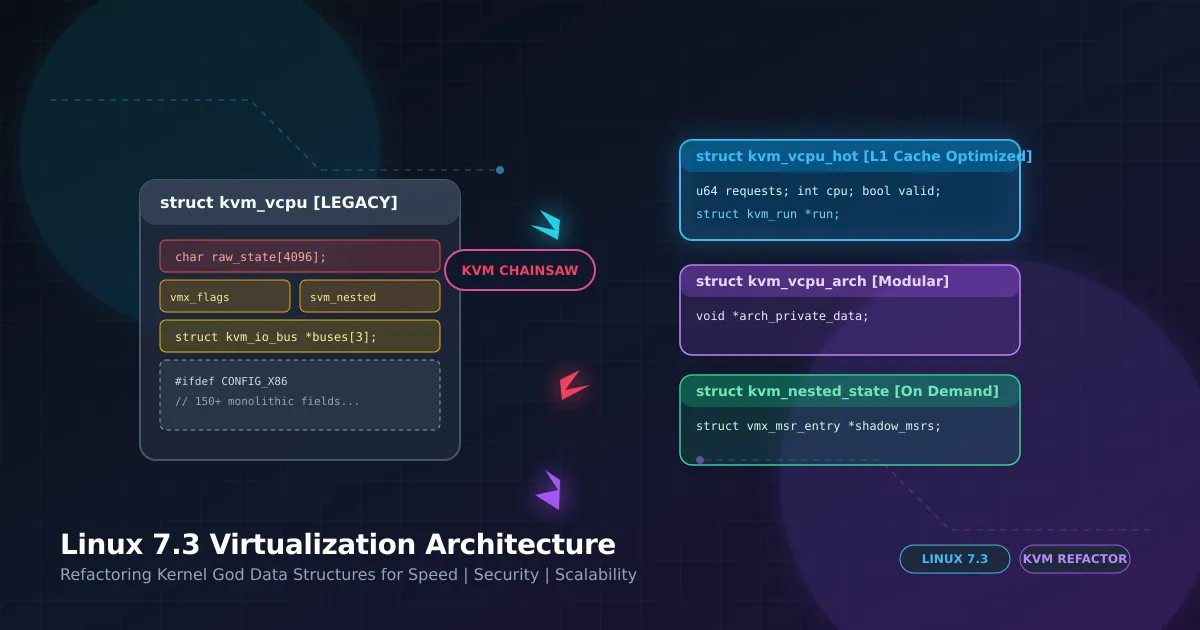
Quick Answer: The Linux ‘KVM Chainsaw’ project is a major architectural refactoring effort targeted for Linux 7.3 that breaks down the monolithic
struct kvmandstruct kvm_vcpu“God Data Structures” into modular, domain-specific sub-structures. This cleanup dramatically reduces cache misses, simplifies architecture-specific hypervisor maintenance, and mitigates security attack surfaces across modern Linux virtualization stacks.
The Monolith Within: The Linux Kernel’s “God Data Structure”
In large-scale, long-lived C codebases, technical debt rarely announces itself with a sudden crash. Instead, it accumulates silently, line by line, over decades of feature releases. In the Linux Kernel-based Virtual Machine (KVM) subsystem—the fundamental hypervisor backbone powering modern cloud infrastructure from Amazon Web Services to Google Cloud Platform—this technical debt coalesced into a famous architectural anti-pattern: The God Data Structure.
Specifically, structures like struct kvm and struct kvm_vcpu (virtual CPU) grew into behemoths. Originally designed to hold core virtualization state, years of continuous expansion added fields for vendor-specific extensions (Intel VMX, AMD SVM), architecture quirks (x86, ARM64, RISC-V, S390), nested virtualization timers, interrupt controllers, and legacy hardware emulation hooks.
By the time developers started planning for the Linux 7.3 release cycle, struct kvm_vcpu contained hundreds of members spanning kilobytes of contiguous memory, crisscrossed by conditionally compiled #ifdef blocks.
This accumulation created several critical pain points for system engineers:
- Cache Inefficiency: Modern CPU architectures thrive on cache locality. When a data structure spans multiple cache lines (64 bytes each), accessing unrelated fields located within the same monolithic structure triggers unnecessary L1 and L2 cache line fetches, degrading hypervisor context-switching performance.
- Architectural Coupling: Core hypervisor code generic to all architectures became entangled with x86-specific hardware flags, making ports to emerging architectures like RISC-V needlessly cumbersome.
- Compile-Time Fragility: Modifying a single header file defining
struct kvmroutinely triggered massive, multi-minute re-compilations of the entire kernel tree due to deep header dependency chains.
Enter the ‘KVM Chainsaw’: Surgical Refactoring at Kernel Scale
To eliminate this structural bloat, kernel maintainers introduced an aggressive refactoring effort affectionately dubbed the “KVM Chainsaw”.
Rather than executing a risky, ground-up rewrite—a non-starter for production software supporting trillions of dollars in global digital infrastructure—the KVM Chainsaw operates via surgical decomposition. The initiative systematically carves the monolithic structs into tightly scoped, modular components.
+-------------------------------------------------------------------+
|                       LEGACY STRUCT KVM_VCPU                      |
|  [Generic State] [x86 VMX] [AMD SVM] [Timers] [Interrupt Matrix]  |
+-------------------------------------------------------------------+
                                  │
                                  │  (KVM Chainsaw Refactor)
                                  ▼
+-----------------------+ +-----------------------+ +---------------+
|  struct kvm_vcpu_core | |  struct kvm_vcpu_arch | | kvm_timer_ops |
+-----------------------+ +-----------------------+ +---------------+
Key Architectural Shifts in the Chainsaw Refactor
- Composition Over Monolithic Inheritance: Instead of burying hardware-specific fields directly inside generic structures, the new architecture uses opaque pointers and domain-specific sub-structures.
- Dynamic Memory Allocation for Optional Features: Features like nested virtualization (running a hypervisor inside a virtual machine) now allocate their state tracking structures dynamically on demand, rather than occupying footprint for every standard guest instance.
- Strict Interface Boundaries: Subsystems like memory management, vCPU scheduling, and device passthrough communicate across clean function pointer boundaries, enforcing encapsulation within C.
Cache Alignment and Performance Implications for Cloud Scale
Why should systems architects, founders, and devops engineers care about a C struct refactor in the kernel? Because at hyper-scale, microscopic CPU instruction savings translate into massive financial and energy savings.
Consider the lifecycle of a virtual machine context switch. Every time a guest VM exits to the host hypervisor (a VM-exit event caused by I/O requests, page faults, or special CPU instructions), the host CPU must save guest registers and inspect the kvm_vcpu state.
+------------------------------------------------------------------------+
|                          CACHE LINE BENCHMARK                          |
+------------------------------------------------------------------------+
| Unrefactored Struct: [Cache Line 1] [Cache Line 2] ... [Cache Line 32] |
|                      └─────── Miss ───────┘                            |
|                                                                        |
| Modular Sub-Structs: [Hot Execution Path: Cache Line 1]                |
|                      └─────── Hit! ────────┘                           |
+------------------------------------------------------------------------+
When fields accessed during hot execution paths are scattered across a 4KB struct, the CPU suffers frequent L1 cache misses. By consolidating hot path variables into a dedicated, 64-byte aligned sub-structure (kvm_vcpu_hot), the KVM Chainsaw ensures that high-frequency VM-exit handlers hit hot cache lines almost 100% of the time.
For high-throughput workloads—such as low-latency financial trading engines, real-time gaming backends, and multi-tenant database clusters—this optimization slashes context-switching tail latencies by measurable percentages.
Cybersecurity Hygiene: Reducing Attack Surfaces in Virtualization
Refactoring code isn’t merely an exercise in raw speed; it is a vital pillar of defensive software engineering. God Data Structures are notorious vectors for memory corruption vulnerabilities, out-of-bounds reads, and privilege escalations.
When dozens of distinct sub-components directly manipulate fields in a shared, unencapsulated struct, tracking memory mutation invariants becomes mathematically intractable. A bug in an obscure legacy device emulation routine can potentially overwrite memory offsets reserved for host memory protection tables.
By decoupling these components, kernel engineers create strict memory isolation boundaries. If an attacker discovers a vulnerability in an architecture-specific emulation module, pointer isolation prevents arbitrary memory writes from corrupting adjacent generic hypervisor state.
As kernel security evolves alongside advanced offensive AI tooling—a trend explored deeply in our analysis of next-generation threat detection—maintaining strict architectural boundaries in infrastructure-level C code is becoming the gold standard for zero-day mitigation.
Technical Takeaways for Developers and Engineering Leaders
The KVM Chainsaw refactoring project offers foundational design lessons for software developers, tech leaders, and startup founders managing growing codebases:
1. Resist the “Dumpster Class” Pattern Early
Whether you are writing C kernel modules, Rust microservices, or TypeScript web APIs, monitor your codebases for “dumpster classes” or “God objects.” When a single domain object becomes required by more than 50% of your application’s routes or execution modules, it is time to break it down.
2. Prioritize Data Locality Over Pure Abstraction
In performance-critical software systems, the layout of data in physical memory matters as much as algorithm efficiency ($O(n)$ complexity). Always group variables by their temporal and spatial execution access patterns.
3. Embrace Refactoring as Continuous Maintenance
The Linux kernel maintainers didn’t wait for KVM to break; they recognized that technical debt would limit future architecture support (like RISC-V hypervisors) and proactively spent developer cycles on structural hygiene. Allocate at least 15-20% of your engineering roadmap to refactoring structural technical debt.
Looking Ahead: The Linux 7.3 Virtualization Era
As the patches comprising the KVM Chainsaw effort merge ahead of the Linux 7.3 kernel release, the hypervisor landscape is positioned for its cleanest architectural era in a decade.
For developers building next-generation cloud infrastructure, micro-VM frameworks (like Firecracker and Cloud Hypervisor), and edge computing nodes, these kernel-level refactors guarantee lower memory footprints, tighter security, and greater execution predictability across diverse CPU architectures.
The lesson from the Linux kernel is clear: no matter how large or critical a codebase becomes, no data structure is too sacred to be sliced down for the sake of long-term maintainability and speed.