
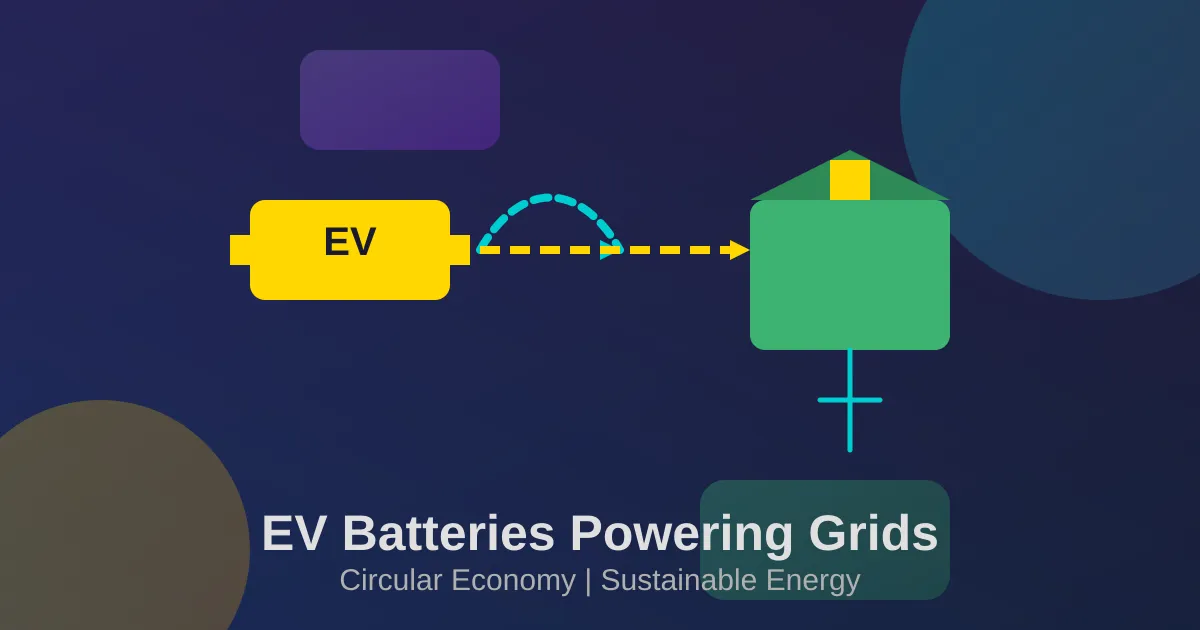
Waymo's Second Act: EV Batteries Powering the Grid
Published on June 5, 2026
Quick Answer: Waymo is repurposing used batteries from its robotaxi fleet to serve as backup energy storage for power grids, demonstrating a pivotal step towards a circular economy for electric vehicles and enhanced grid resilience.
The global energy landscape is undergoing a monumental transformation. With the urgency of climate change and the accelerating shift towards renewable energy sources, the challenge of reliable energy storage has never been more critical. Simultaneously, the electric vehicle (EV) revolution, while crucial for decarbonizing transport, presents its own looming challenge: what happens to the massive volume of batteries reaching their automotive “end-of-life”?
Enter Waymo, the autonomous driving technology company, which is now pioneering an innovative solution that tackles both problems simultaneously. By giving its used robotaxi batteries a powerful second life as stationary energy storage for power grids, Waymo isn’t just managing waste; it’s forging a path toward a truly circular economy and bolstering the infrastructure vital for our sustainable future. This initiative represents a compelling blend of cutting-edge technology, environmental responsibility, and economic opportunity that should resonate deeply with developers, founders, and tech enthusiasts alike.
The Rise of Second-Life Batteries: A Circular Solution
The concept of “second-life” batteries is gaining significant traction as the world grapples with both resource scarcity and the environmental impact of electronic waste. It recognizes that a battery’s usefulness doesn’t simply end when it can no longer meet the demanding performance requirements of an electric vehicle.
The Dual Challenge: EVs and Energy Storage
Electric vehicles require batteries that can deliver high power for rapid acceleration, sustain long ranges, and charge quickly. Over time, through countless charge-discharge cycles, a battery’s capacity degrades. When it drops below a certain threshold—typically 70-80% of its original capacity—it’s no longer optimal for automotive use. Historically, these batteries would then head for complex and often costly recycling processes, or worse, landfills.
Parallel to this, the proliferation of intermittent renewable energy sources like solar and wind power has created a pressing need for robust and flexible energy storage solutions. Grids need to store surplus energy generated during peak production times (e.g., a sunny afternoon) and release it when demand is high or generation is low (e.g., after sunset). Without adequate storage, the full potential of renewables cannot be realized, leading to curtailment or reliance on fossil fuel peaker plants.
Waymo’s Pioneering Approach
Waymo’s strategy directly addresses this dual challenge. Their robotaxi fleet, operating continuously, puts batteries through rigorous cycles. Instead of discarding these units once they fall below automotive performance benchmarks, Waymo is collaborating with partners to repurpose them. These “retired” EV batteries, while no longer suitable for powering a vehicle across hundreds of miles, retain ample capacity and power output for less demanding stationary applications, such as buffering renewable energy, providing backup power, or performing grid stabilization services.
This approach transforms a potential waste stream into a valuable asset, reducing the demand for new battery manufacturing, conserving precious resources, and significantly lowering the carbon footprint associated with both EV production and grid operations. It’s a testament to thinking beyond the primary use case and identifying latent value in existing technologies.
Technical Deep Dive: From Robotaxi to Resilient Grid
The transition of an EV battery from a mobile power source to a stationary grid asset involves sophisticated engineering and intelligent software. This is where modern development practices and innovative tech trends truly shine.
Battery Degradation and Repurposing
When an EV battery is retired from a vehicle, it undergoes a meticulous assessment process. This includes diagnostics to determine its remaining capacity, internal resistance, and overall health. Batteries might be disassembled, and individual modules or even cells might be tested, sorted, and re-packaged into new stationary battery energy storage systems (BESS). The key here is understanding that stationary storage often has different operational profiles: it might require less frequent high-power discharges but demands long-duration reliability. The remaining 70-80% capacity of a “retired” EV battery is perfectly suited for this.
The Role of Battery Management Systems (BMS)
At the heart of any battery system, especially one composed of repurposed units, is the Battery Management System (BMS). For second-life applications, the BMS becomes even more critical. It must:
- Monitor Health: Continuously track voltage, current, temperature, and state-of-charge (SoC) for individual cells and modules.
- Balance Cells: Ensure uniform charge and discharge across all cells to maximize lifespan and prevent overcharging or deep discharging of any single component.
- Predict Lifespan: Use advanced algorithms and machine learning (ML) to estimate the remaining useful life (RUL) of the repurposed battery pack, optimizing its operational strategy.
- Safety Protocols: Implement robust safety features to prevent thermal runaway, overvoltage, or undervoltage conditions.
Developers are crucial in creating sophisticated BMS software, leveraging edge computing and AI to make these systems autonomous and highly efficient. Innovations in predictive analytics, enabled by vast datasets from Waymo’s fleet operations, can lead to even more accurate health assessments and optimized second-life performance.
Integrating into the Smart Grid
Once repackaged and equipped with an intelligent BMS, these second-life battery systems need to seamlessly integrate into the existing power grid infrastructure. This involves:
- Power Conversion: Inverters are necessary to convert the direct current (DC) from the batteries into alternating current (AC) compatible with the grid.
- Grid Interconnection Standards: Adherence to standards like IEEE 1547 for distributed energy resources (DERs) is essential for safe and reliable operation.
- Smart Grid Communication: Utilizing IoT devices and communication protocols (e.g., Modbus, DNP3, IEC 61850) to allow the battery system to communicate with grid operators. This enables services like:
- Peak Shaving: Discharging during periods of high demand to reduce stress on the grid.
- Frequency Regulation: Quickly injecting or absorbing power to stabilize grid frequency.
- Demand Response: Responding to signals from the grid to reduce or increase power consumption/injection.
- Renewable Energy Smoothing: Storing energy from intermittent sources and releasing it steadily.
The development of robust, secure, and scalable software platforms for managing these distributed battery assets is a significant undertaking, combining expertise in embedded systems, cloud computing, and cybersecurity.
Impact and Opportunities for Tech Innovators
Waymo’s initiative isn’t just a feel-good story; it’s a blueprint for a sustainable future and a fertile ground for technological innovation and entrepreneurial ventures.
Economic and Environmental Benefits
The economic advantages are significant. Repurposing batteries can be more cost-effective than manufacturing new ones for stationary storage, lowering the barrier to entry for grid-scale solutions. Environmentally, it reduces the need for new raw material extraction (lithium, cobalt, nickel) and mitigates the complex waste management challenges of spent EV batteries, contributing directly to a circular economy. It also accelerates the adoption of renewable energy by providing essential storage, thereby reducing reliance on fossil fuels.
New Frontiers for Developers: AI, IoT, and Data
For developers, this domain is bursting with opportunities:
- AI and Machine Learning: Develop predictive models for battery degradation, optimal charging/discharging strategies based on real-time grid conditions, weather forecasts, and energy prices. Create AI-driven algorithms for fault detection and anomaly prediction in large battery arrays.
- IoT and Edge Computing: Design and implement robust sensor networks for monitoring battery health, environmental conditions, and grid parameters. Develop edge computing solutions for real-time decision-making, reducing latency and reliance on constant cloud connectivity.
- Data Science and Analytics: Build platforms to collect, process, and analyze massive datasets from thousands of distributed battery systems. Extract insights to improve operational efficiency, safety, and inform future battery designs.
- Software Engineering for Grid Management: Develop sophisticated SCADA (Supervisory Control and Data Acquisition) systems, energy management systems (EMS), and microgrid control software that can orchestrate diverse energy assets, including second-life batteries.
Founder’s Vision: Building the Next Energy Solution
Entrepreneurs and founders should see immense potential. This emerging sector needs innovative companies specializing in:
- Battery Diagnostics & Remanufacturing: Developing advanced, automated systems for testing, grading, and re-packaging second-life batteries.
- Distributed Energy Resource (DER) Aggregation: Creating platforms that can aggregate and manage thousands of small-scale battery storage units, turning them into a virtual power plant that can offer services to the grid.
- Microgrid-as-a-Service: Designing and deploying self-sufficient microgrids for communities, commercial buildings, or remote areas, heavily utilizing repurposed batteries.
- Energy Trading Platforms: Developing sophisticated marketplaces where energy stored in these batteries can be bought and sold based on real-time market dynamics.
- Circular Economy Logistics: Innovating supply chain solutions for collecting, transporting, and deploying second-life batteries efficiently and sustainably.
Challenges and the Road Ahead
While promising, the second-life battery market faces hurdles that require collaborative innovation.
Standardization and Safety
A lack of universal standards for testing, grading, and certifying second-life batteries can hinder widespread adoption. Ensuring the safety of these systems, particularly regarding thermal management and fault protection, is paramount. Robust regulatory frameworks and industry best practices are essential to build trust and scale.
Scaling Production and Deployment
The logistics of collecting, transporting, processing, and deploying batteries at a large scale are complex. This requires significant investment in infrastructure, skilled labor, and efficient supply chain management. Establishing clear end-of-life pathways for second-life batteries (i.e., when they are truly spent and require recycling) is also critical for a complete circular model.
Battery Chemistry Evolution
As battery chemistries continue to evolve (e.g., solid-state batteries, sodium-ion), the methods for repurposing and recycling will also need to adapt. Staying ahead of these technological shifts is crucial for long-term viability.
Conclusion
Waymo’s initiative to repurpose robotaxi batteries for grid storage is more than just a smart business move; it’s a powerful demonstration of how technological innovation can drive sustainability and create new value. It highlights a critical pathway for the circular economy, transforming potential waste into a vital component of our future energy infrastructure.
For developers, this field offers a sandbox for AI, IoT, data science, and advanced software engineering. For founders, it presents a burgeoning market ripe with opportunities to build the next generation of energy solutions. As we push towards a greener, more resilient future, the intelligent repurposing of resources like EV batteries will be indispensable. The journey from autonomous vehicle to grid stabilizer is just beginning, and its success will depend on the ingenuity and collaborative spirit of the global tech community.