Why Grok Build's Zero Data Retention Changes AI Coding
Published on July 19, 2026
Quick Answer: The open-sourcing of the ‘Grok Build’ developer environment, combined with its strict zero-data-retention policy, provides engineering teams with a highly secure, privacy-first framework for AI-assisted coding. This milestone directly addresses enterprise concerns regarding proprietary code leaks and intellectual property safety.
The landscape of software engineering has shifted dramatically over the last two years. AI coding assistants are no longer novelty tools; they are foundational infrastructure. Platforms like GitHub Copilot, Cursor, and Replit have proven that LLM-driven generation can accelerate development cycles by order-of-magnitude factors.
Yet, for all their productivity gains, a massive compliance bottleneck has persisted: data privacy.
Enterprises, financial institutions, and defense contractors have historically banned or severely restricted AI coding tools due to the threat of intellectual property (IP) leakage. The fear that proprietary codebases could be ingested, stored, and used to train future public models has kept some of the world’s best engineering teams on the sidelines.
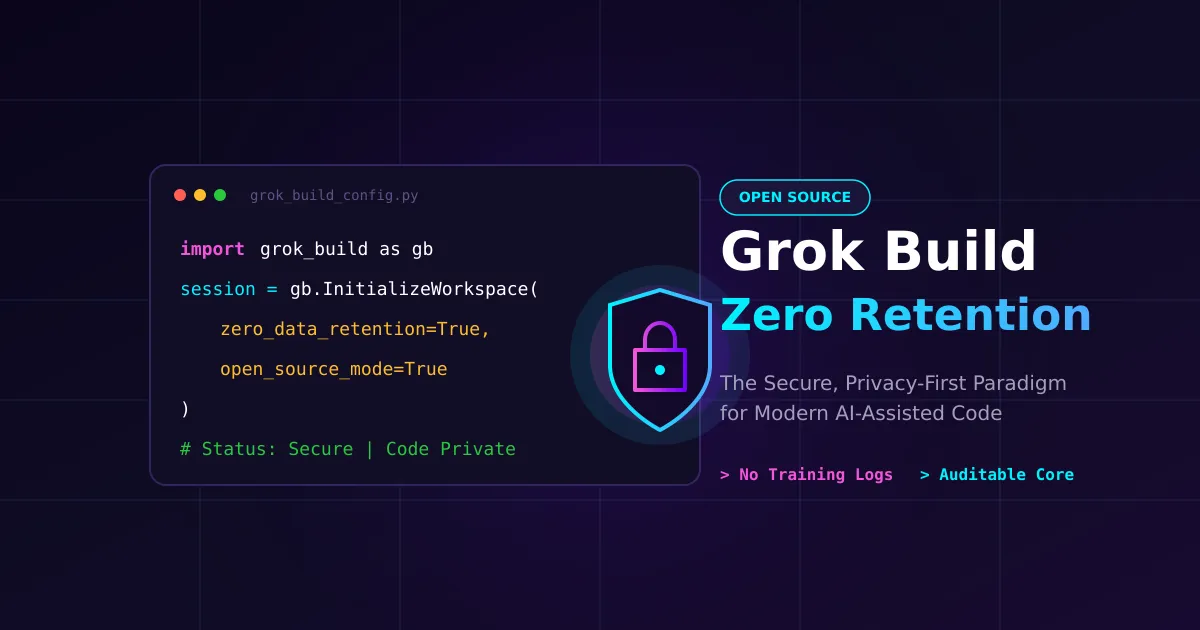
The open-sourcing of the Grok Build developer toolchain, backed by a strict Zero Data Retention (ZDR) guarantee, marks a pivotal moment in the democratization of secure AI-assisted development.
What is Grok Build?
Grok Build is a highly optimized development environment designed to integrate deeply with large language models to automate code generation, debugging, and system architecture mapping. By open-sourcing this toolchain, xAI has shifted the power dynamic back to the developer community.
Instead of forcing engineers to rely on closed-loop, proprietary SaaS platforms, Grok Build allows teams to inspect the underlying source code, run the environment locally or within private clouds, and fully customize the integration touchpoints.
The release is particularly significant because it addresses the “black box” problem of modern developer tools. When you use a proprietary AI extension, you are trusting a third party with your entire active workspace—including environment variables, proprietary algorithms, and internal API structures. Grok Build’s open-source nature allows security architects to audit every outgoing network request, ensuring that no unauthorized telemetry leaves the local environment.
The Power of Zero Data Retention (ZDR)
In the enterprise software space, “Zero Data Retention” is the ultimate security gold standard. It means that any data transmitted to an AI model for inference is processed purely in-memory, returned to the user, and immediately purged. It is never written to persistent disks, never logged for debugging, and absolutely never used for downstream model training.
For CTOs and CISOs, ZDR is a non-negotiable requirement. We have already seen high-profile incidents where sensitive corporate intellectual property was accidentally leaked into public LLM training sets via standard consumer-grade AI chat interfaces.
By hardcoding ZDR protocols into the open-source architecture of Grok Build, developers can leverage cutting-edge code completion and reasoning models without compromising compliance frameworks like SOC 2, ISO 27001, or GDPR.
Bridging the Gap: Economic Pressures and Open Source
The push toward open-source developer tooling isn’t just about security; it is also a response to shifting economic realities. Over the past several years, organizations have faced intense pressure to optimize their SaaS spend. Licensing costs for proprietary AI seats can quickly scale into the tens of thousands of dollars annually for mid-sized engineering departments.
Just as modern fintech solutions for personal finance have surged to help consumers navigate shifting markets and optimize their cash flow, enterprise tech leaders are auditing their operational overhead. Open-source, self-hosted alternatives like Grok Build allow companies to bypass expensive per-seat licensing models. By deploying Grok Build on their own virtual private clouds (VPCs) or leveraging existing cloud compute credits, startups and enterprises can scale AI utility to their entire engineering staff at a fraction of the cost.
How Grok Build Compares to the Competition
To understand the impact of this release, it helps to compare Grok Build’s architectural philosophy with other major players in the AI coding space:
| Feature | Grok Build (Open Source) | GitHub Copilot | Cursor |
|---|---|---|---|
| Codebase Access | Fully Open Source | Closed Source | Closed Source (Editor) |
| Deployment | Self-hosted, Local, or Cloud | Managed Cloud Only | Managed Cloud / Local API |
| Data Retention | Zero Retention Guaranteed | Configurable (Enterprise only) | Opt-out required |
| Customizability | Infinite (Modify source code) | Limited to extension settings | Medium (Custom prompt rules) |
While GitHub Copilot remains the market leader due to its seamless integration with the GitHub ecosystem, its closed-source nature makes it a difficult sell for high-security environments. Cursor has captured the hearts of early adopters with its elegant UX, but it still relies heavily on proprietary middleman APIs. Grok Build carves out a unique niche by prioritizing transparency, absolute user control, and enterprise-grade privacy out of the box.
Setting Up a Privacy-First AI Development Workflow
For developers and founders looking to migrate to a secure, open-source AI workflow using Grok Build, here is a high-level blueprint for implementation:
1. Isolated API Gateways
To ensure the Zero Data Retention promise is enforced, route all Grok Build API traffic through an internal proxy or API gateway. This allows your security team to monitor payload sizes, log access requests, and inject custom security policies before requests leave your network perimeter.
2. Local Context Pruning
One of the key features of Grok Build is its ability to parse your local workspace to provide context-aware suggestions. Developers can configure local .grokignore files (similar to .gitignore) to ensure that highly sensitive configuration files, local database seeds, and private keys are never read by the AI parser.
3. Hybrid Inference Models
Because Grok Build is open source, you are not locked into a single model provider. You can configure the toolchain to route simple autocomplete tasks to small, ultra-fast local models (like Llama-3-8B running on a local workstation) while routing complex architectural refactoring tasks to the secure, zero-retention Grok cloud APIs.
The Future of Enterprise AI is Open and Secure
The open-sourcing of Grok Build represents a broader philosophical shift in the tech industry. The initial gold rush of AI development was defined by proprietary gatekeeping, where tech giants raced to build walled gardens around their models and developer interfaces.
However, developers have always favored open ecosystems. The tools that ultimately win the hearts of the engineering community are those that respect developer autonomy, offer deep customizability, and protect user data. By combining cutting-edge engineering capabilities with an uncompromising stance on data privacy, Grok Build is setting a new benchmark for how modern software will be written.